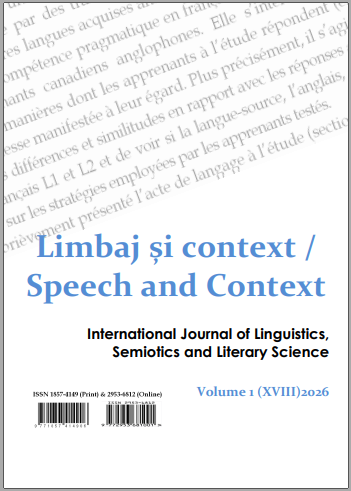
Vol. 1 No. 18 (2026)

					View Vol. 1 No. 18 (2026)

It contains 15 materials written by researchers from 6 countries: Canada, Kingdom of Morocco, Oman, Gabonese Republic, Romania, and Republic of Moldova. These materials include 15 research articles. The authors examine subjects connected with Linguistics, Computer Linguistics, Comparative Linguistics, Applied Linguistics, Pragmatics, Language Philosophy, and Translation Studies. They propose investigations in English, French, German, and Spanish on the following topics: Types of sign, speech and interactional mechanisms in communication; (Literary) language and social conditioning; Language, Context, Translation, and Teaching and Learning Languages and Literatures. See Vol. 1 No. 18 (2026) full text.  

Published: 12.09.2026

Research articles

  • An Interview with the Machine-Inquiring Speech in ChatGPT: The Self-Description of its Capabilities by an AI Chatbot

    Fee-Alexandra Haase
    15-35
    DOI: https://doi.org/10.62413/lc.2026(1).01
  • Reproches et gestion des faces en situation de proximité sociale au Cameroun

    Bernard Mulo Farenkia
    36-62
    DOI: https://doi.org/10.62413/lc.2026(1).02
  • L’ implicite entre impératif de justification et dynamique de mobilisation préélectorale

    Badreddine EL-Kacimi
    63-72
    DOI: https://doi.org/10.62413/lc.2026(1).03
  • El rumañol en Almería: características y perspectivas de desarrollo

    Roman Jafarov, Tatiana Gorea
    73-82
    DOI: https://doi.org/10.62413/lc.2026(1).04
  • The Role of Language in the Constitution and Expression of Human Authenticity

    Ecaterina Dmitric
    85-94
    DOI: https://doi.org/10.62413/lc.2026(1).05
  • Considérations générales sur le concept de dignité avec application par rapport au roman « Eugénie Grandet » d’Honoré de Balzac

    Victoria Brăiescu
    95-104
    DOI: https://doi.org/10.62413/lc.2026(1).06
  • Analyse de l’aspect morphosyntaxique dans la nouvelle fantastique « L’homme du sable » d’Ernst Theodor Amadeus Hoffmann

    Lamiae Slaoui
    105-115
    DOI: https://doi.org/10.62413/lc.2026(1).07
  • Lenguaje obsceno: entre uso y tabúes

    Victoria Barcaru
    116-127
    DOI: https://doi.org/10.62413/lc.2026(1).08
  • Translating Childlike Logic in ”Oscar et la dame rose” (Oscar and the Lady in Pink) by Éric-Emmanuel Schmitt

    Ecaterina Foghel, Daniela Hăisan
    131-143
    DOI: https://doi.org/10.62413/lc.2026(1).09
  • Linguocultural Objectification of the Concept “Agreement” in Scientific and Educational Audiovisual Discourse Based on the Original Animated Series “The Fixies” and its Translation into English and Romanian

    Tatiana Bogdanici, Anton Zazuleac
    144-150
    DOI: https://doi.org/10.62413/lc.2026(1).10
  • Le traducteur comme figure de l'entre-deux dans l'œuvre de Jacques Poulin

    Marthe Prisca Letsetsengui
    151-178
    DOI: https://doi.org/10.62413/lc.2026(1).11
  • Der Weg nach innen: Die Übersetzung der spirituellen Suche in Ana Blandianas Lyrik und ihre Rezeption im Deutschen

    Elvira Guranda, Lina Cabac
    179-190
    DOI: https://doi.org/10.62413/lc.2026(1).12
  • Integrating Generative AI in Language for Specific Purposes Instruction: A Case Study on Job Interview Preparation in Veterinary Medicine

    Elena Velescu, Roxana Mihalache
    193-203
    DOI: https://doi.org/10.62413/lc.2026(1).13
  • Affordances numériques et multimodalité : effets sur l'engagement langagier des élèves de fin de cycle primaire dans une école pionnière

    Chdid Driss
    204-217
    DOI: https://doi.org/10.62413/lc.2026(1).14
  • Exploring Learner Engagement in EFL Higher Education: A Mixed-Methods Study

    Silvia Bogdan
    218-232
    DOI: https://doi.org/10.62413/lc.2026(1).15